Cutting Technologies: Waterjet and Fiber Laser
What are waterjet and fiber laser cutting, how do they work, and when is each preferred? Explained with the technical fundamentals and advantages.
The right cutting method depends on material, thickness, tolerance and the part's function. Below you will find how the three core technologies work, their concrete technical specs and their advantages. For a comparative selector, head to the Cutting Method page.
What Is Waterjet Cutting?
High-pressure cold cutting — any material, no heat effect
Waterjet is a cold cutting process in which a fine stream of water — enriched with an abrasive when needed — is forced through a nozzle at very high pressure and erodes the material. Because no heat is used, no heat-affected zone (HAZ) forms during the cut, which makes it the preferred method for aerospace alloys and composites.
How does it work?
A high-pressure pump compresses water to working pressure; in waterjet systems this can reach the order of 6,000 bar. The water passes through an orifice a fraction of a millimetre across and reaches supersonic speed. On metals and hard materials an abrasive such as garnet is added to the stream (abrasive waterjet); on soft materials a pure (abrasive-free) waterjet is enough. The stream cuts by mechanical erosion, producing no chips and no heat.
Abrasive vs. pure waterjet
Pure waterjet uses water only and is preferred for soft/thin materials such as gaskets, foam, food and paper. Abrasive waterjet adds an abrasive to the water and can cut hard materials such as metal, glass, ceramic and composite. Abrasive waterjet is at the centre of our capability; abrasive flow and cutting speed are tuned to the desired surface quality.
Surface quality (Q1–Q5)
Edge quality in waterjet cutting is usually graded from Q1 to Q5. Q1 is the fastest, most economical separation cut, while Q5 is the smoothest, most precise edge (and the slowest cut); edge roughness and slight taper increase towards Q1. We choose the right grade together based on your part's function.
Why is it preferred in aerospace?
Because cold cutting creates no heat-affected zone (HAZ) or micro-cracks in the material, the metallurgical integrity of alloys such as aluminium, titanium, inconel and stainless steel is preserved. This avoids thermal distortion and structural weakening on critical parts and reduces the need for secondary operations (grinding, stress relief).
Advantages
- Cold cut → no heat-affected zone (HAZ) → metallurgical integrity preserved, no micro-cracks on aerospace alloys
- Taper-compensated, square, burr-free edge → less need for secondary operations
- One of the few methods that cut almost any material (metal, glass, composite)
- Complex, curved geometry and nested patterns in a single piece
Technical specs
- Working pressure
- Up to 6,000 bar
- Heat effect (HAZ)
- None — cold cut
- Typical tolerance
- ± 0.05 – 0.2 mm (by thickness)
- Max thickness capability
- Up to ~300 mm (by material)
- Surface quality
- Q1 – Q5 options
Suitable materials
Related services
Choose your edge: Q1 to Q5
Waterjet edge quality is graded in five steps: Q1 is the fastest, most economical separation cut and Q5 is the smoothest, most precise edge. Pick a grade to see what the edge looks like and what it suits.
Q3 — Standard
The grade where speed, cost and finish balance out — the sensible default for most contract jobs. The edge is largely smooth, with slight marking possible near the bottom.
- Cutting speed
- Economy
- Surface finish
Where to use it?
General fabrication parts, machine components, flanges and brackets.
Why cold cutting matters in aerospace
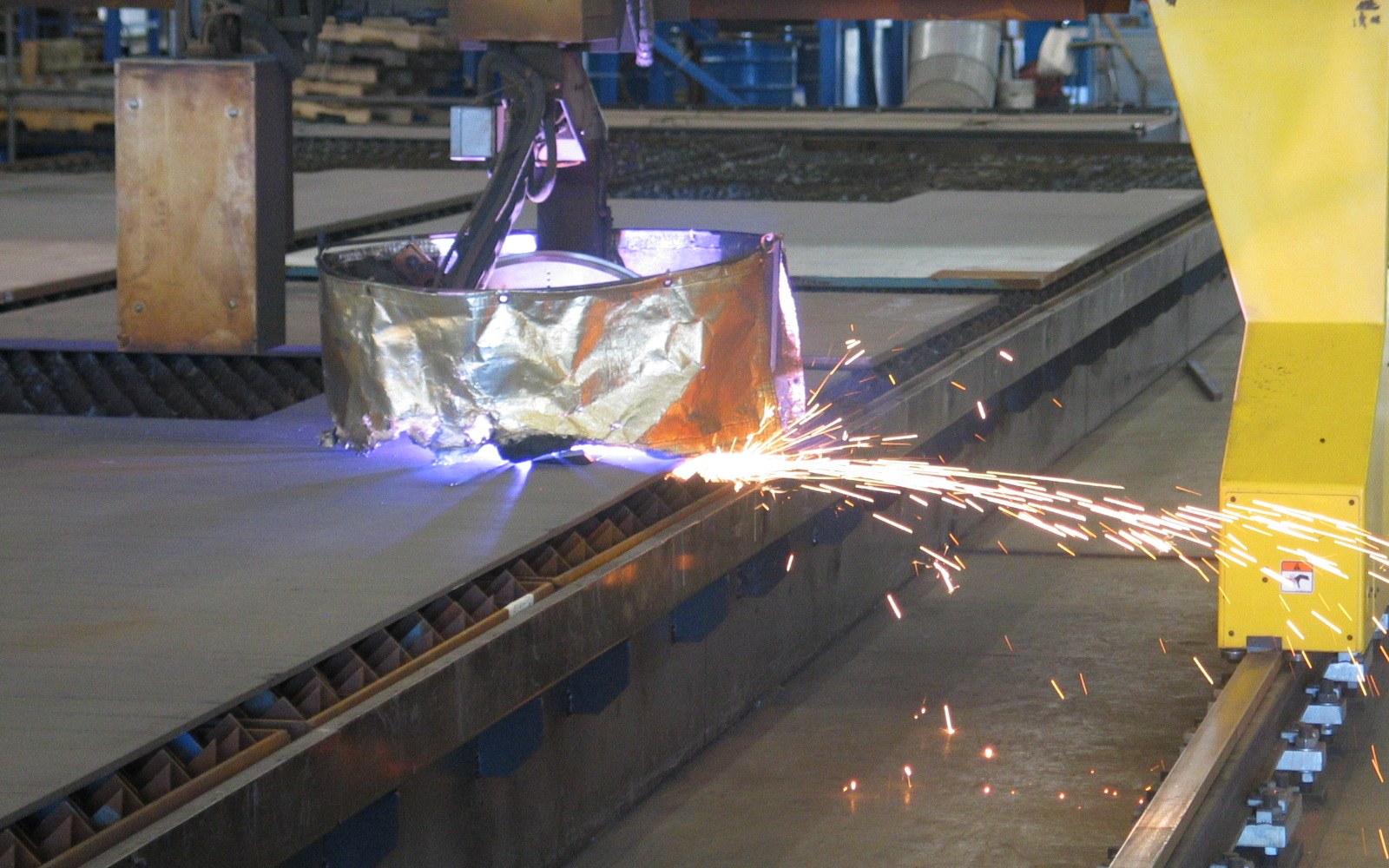
Thermal cutting
Heat-affected zone (HAZ)
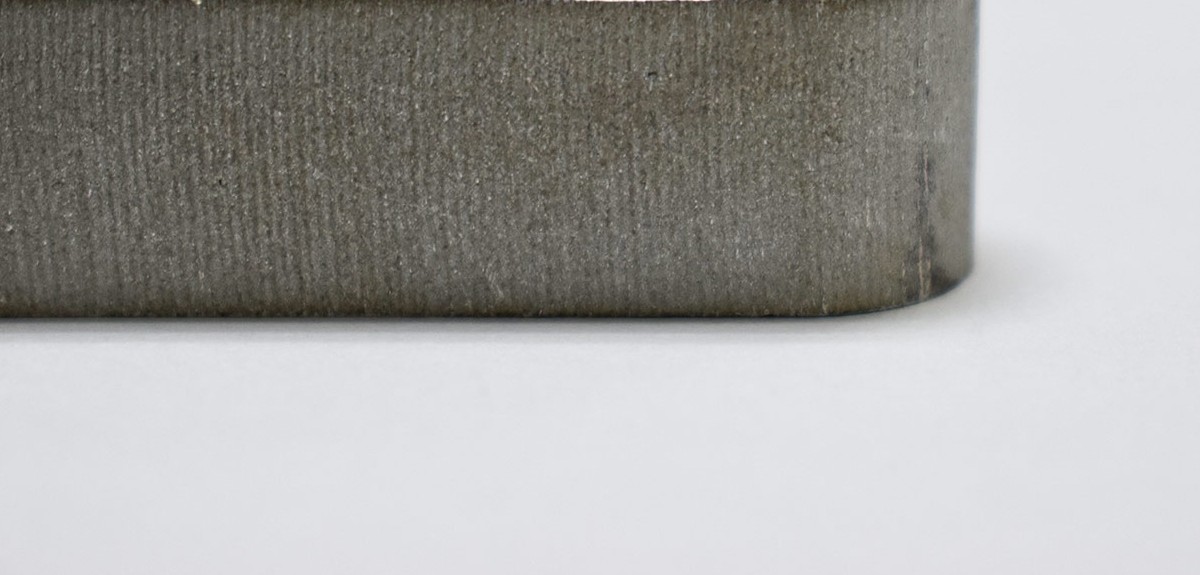
Waterjet — cold cutting
Microstructure unchanged
No HAZ forms
Because no heat-affected zone forms at the cut edge, the material's mechanical properties are preserved.
No micro-crack or hardening risk
No heat-induced micro-cracks or hardening at the edge — supporting fatigue life on critical parts.
No thermal distortion
The part never heats up, so it never warps; dimensional stability is preserved even on thin, delicate parts.
What Is Fiber Laser Cutting?
High speed, narrow kerf and crisp detail for thin-to-medium sheet
Fiber laser cutting is a thermal process in which a high-power laser beam, delivered through optical fibre and focused, melts sheet metal while an assist gas blows the melt away. It offers the highest productivity, a narrow kerf and crisp detail on thin and medium-gauge sheet metal.
How does it work?
The beam from the fiber laser source melts or vaporises the material surface at a focused spot. An assist gas (oxygen, nitrogen or air) ejects the molten material from the kerf. The process runs very fast under CNC control, which makes it economical for volume production on thin-to-medium sheet.
Heat effect (HAZ) and limits
Laser is a thermal process, so a narrow heat-affected zone (HAZ) forms at the cut edge. In most structural applications this is negligible; but on aerospace alloys where metallurgical integrity is critical, waterjet may be preferred. Laser is also limited on glass and some reflective metals (e.g. high-copper).
Low scrap via nesting
Automatic nesting software places parts on the sheet as efficiently as possible to minimise scrap. The narrow kerf and precise positioning produce small holes, fine bridges and sharp corners at repeatable quality.
Advantages
- Highest speed on thin-medium sheet → low unit cost in volume
- Narrow kerf → sharp corners, small holes, fine bridges
- Low scrap via automatic nesting
- Marking and engraving capability
Technical specs
- Heat effect (HAZ)
- Yes — narrow HAZ
- Repeatability
- ± 0.03 mm (thin-medium sheet)
- Max thickness capability
- Steel ≤ 25 mm · stainless ≤ 30 mm · aluminium ≤ 20 mm
- Edge
- Narrow kerf, crisp detail; thin HAZ trace
Suitable materials
Related services
Not sure which method suits your part? Compare them by material and thickness.
Ready for your project
Upload your technical file and get your price quote within 24 hours. No drawing yet? Upload a photo and we'll handle the rest.